Vita believes that all the living things on Earth are parts of a single super-organism called Gya. Gya is the simple name. More formally, and framed as a biological species name, she is called Imperium vitae-planeta — or just Vitae-planeta.
The concept of Gya suggests all humans can be thought of as cells in a body with responsibilities to look after the interests of the host.
As a living organism, Gya displays homeostasis — the ability to regulate temperature and chemical equilibrium of her body. Unless she is sick. Human activities (particularly burning fossil fuels) have made Gya sick, and her temperature is rising.
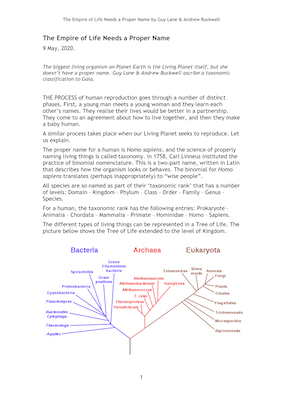
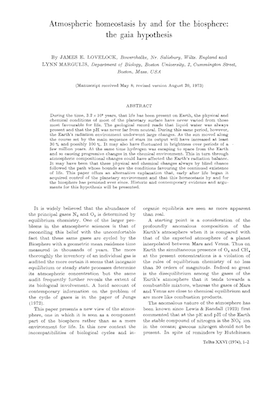
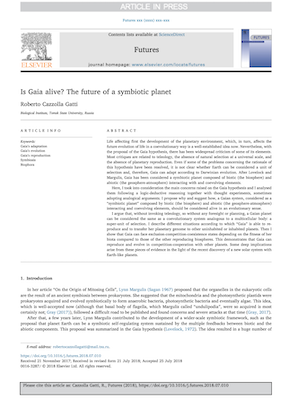
Some people may know Gya by the name Gaia, as per Gaia Theory by James Lovelock & Lyn Margulis. There are two subtle distinctions:
1 — Gaia says that all life on Earth behaves in the manner of an organism, whereas Gya says that all life on Earth is an organism.
2 — Gaia is a scientific theory, whereas Gya is a spiritual belief.
Other names include Mother Nature, Pachamama or the Living Planet.
Not God
Vita Sapien Philosophy does not view Gya as a God, a deity, the creator of the universe or anything remotely like a conscious being with intent.
One of Trillions
Gya is an emergent property of the laws of nature playing out on a planet within the habitable zone of its star. There are probably trillions of Gyas on planets around the Universe. To make a distinction, a self-regulating biosphere is referred to as PANANIMA, and the self-regulating biosphere of Planet Earth is referred to as Gya.
Wide & Thin
The closest analogue to Gya would be a giant lichen that lives on the surface of a boulder. It has the shape of a thin skin, about 1% of the diameter of the globe.
Above and Below Vita
Above Gya is the frigid depth of space, and below Vitae-planeta is the Earth's mantle (molten rock). Gya's wispy outer boundary is about 100 kilometres above the ground, and its lower depth is some kilometres below the seafloor in the Earth's crust.
Very Old
Gya has endured over 3 billion years because she maintains internal chemical and thermal equilibrium that is conducive to life. If the Universe is 13.8 billion years old, that makes Gya about one-quarter the age of the Universe.
He, She or It?
Technically, Gya would be referred to as an 'it' as it is a gender-less non-human species. However, out of reverence Gya is referred to as 'she'.
Pondering
While one can ponder Gya, Gya cannot ponder us per se. Gya is not conscious and she doesn't observe us. We humans can ponder on Gya's behalf. Humans are the part of Gya that ponders.
Non-judging, but reacting
While Gya doesn't judge us for our actions, she does respond to them at the global scale. We are, after all, now living in the Anthropocene Epoch in which humans are the main drivers of change on the Earth. Pumping 43 gigatons of CO2 a year into Gya, and sending legions of her organisms extinct, will not come without consequence. As Gya turns on us humans, it won't be because she is angry. It will just be.
Diurnal / Nocturnal
Gya is the only organism that is simultaneously in both night and day, and in every phase in between. Gya never sleeps. She is always in an equivalent state of consciousness.
Suitable for the Human Race
Over the past 3.8 billion years, Gya has existed in many forms not all of which were suited to human habitation. Gya's climate has been ideal for the growth of human civilization over the past 12,000 years, but our actions are shifting Gya into a new phase that will be hostile to humans.
Mutually Bound
The future of the humans is in Gya's hands as we are dependent on a healthy planet for our survival. However, Gya does have some need for us. In the first instance, humans are needed to clean up the mess left behind by the humans — the trillion tons of CO2 in the atmosphere, the plastics in the ocean, the 450 nuclear reactors that will eventually fail without human maintenance.
If we do not fix this mess, Gya will suffer greatly, shedding massive amounts of biodiversity and potentially losing her homeostasis.
Secondly, over much longer time-frames, Gya's future is in our hands because she will eventually succumb to the Red Giant as the Sun expands. An option therefore exists for humans to depart to another planet and take parts of Gya with us — though this need not be planned for several million years at minimum.